When many actions succeed at a state, regression outputs their average, which can itself fail. Pan et al. (2026) find that a minimal two-step policy trained with noise matches flow matching on behavior cloning, and that it needs both the noise and the second step, but leave the mechanism open. Here is one: a step trained on noisy inputs averages only the successful actions near its input, so its output stays among them when the noise is large enough to reach them and small enough that they look flat within it.
Setup
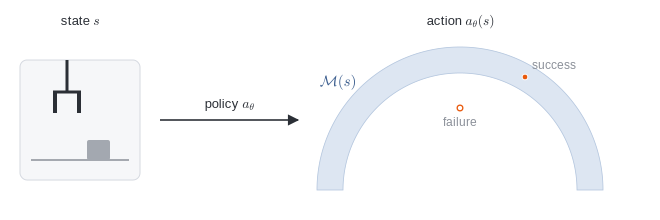
A policy maps a state to an action . For each state, the actions that succeed form a set . By the manifold hypothesis, this set is typically a thin band around a curved, lower-dimensional manifold. The band has width because tiny differences do not matter: a robot’s motors have limited precision. Training never sees directly, only demonstrations. For simplicity, the expert at each visited state samples .
Regression Averages Globally
Regression fits by minimising, averaged over visited states, . A state often has many successful actions, but the policy outputs only one, so it must compromise between them. The compromise squared error picks is a standard result:
Theorem
Let be a random vector in with finite second moment. Among all constants , the unique minimiser of is .
Proof
Let . Then
since . The first term does not depend on and the second is zero only at .
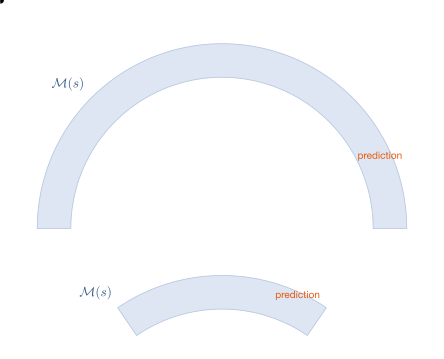
At a fixed state , the prediction is a constant and the expert action plays , so regression predicts , the centroid of . Nothing forces the centroid to lie in .
Each SGD step pulls the prediction towards a random expert action, so it settles at their mean: in the empty middle of a semicircle (top), but on the band for a short arc (bottom).
Iterative Policies
Pan et al. attribute the success of diffusion and flow matching to two ingredients acting together: iteration and training noise. Both methods have much else besides. To keep only these two ingredients, they propose a minimal iterative policy (MIP). We use a variant with uniform rather than Gaussian noise and call it the silly minimal iterative policy (SMIP).
Training. SMIP has two heads, and . For each demonstration , draw uniformly from the unit ball and set for a fixed radius . Both heads regress onto the expert action:
Inference. The heads run in sequence, with no noise:
Iteration Averages Locally
The first head sees only , so by the theorem its prediction is the centroid of , the same compromise regression makes. Any gain must come from the second head, the only one trained on noisy inputs.
Head 2 sees and , so by the theorem it predicts . In training, every input to head 2 was an expert action pushed at most away. Since the expert and the noise are both uniform, every successful action within of is equally likely to have produced , so is their centroid.
If is close to , a ball that just reaches cuts out a small, nearly flat patch around the nearest point. The centroid of such a patch lies in the patch, so head 2 lands close to .
That needs at least the distance from to , or head 2 never saw such an input in training. It also needs small enough that looks flat within it, or the ball cuts out a curved stretch whose centroid is off , head 1’s mistake again.
Experiment
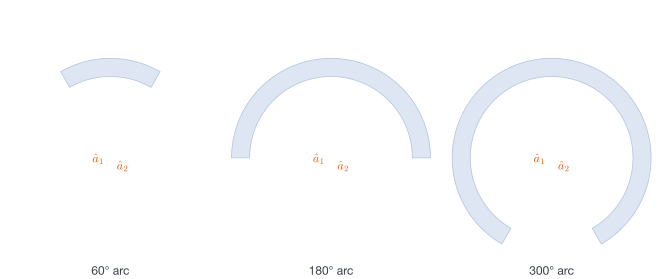
The previous section predicts a window for . Does such a window always exist? We train SMIP on arcs of growing angle and sweep .
On the 60° arc, every works: the whole arc is nearly flat, so whatever part the ball cuts out, its centroid stays on the band. On the semicircle, lands on the band only for between about 0.2 and 0.7. On the 300° arc, no works: by the time the ball reaches the band, it covers most of the arc.
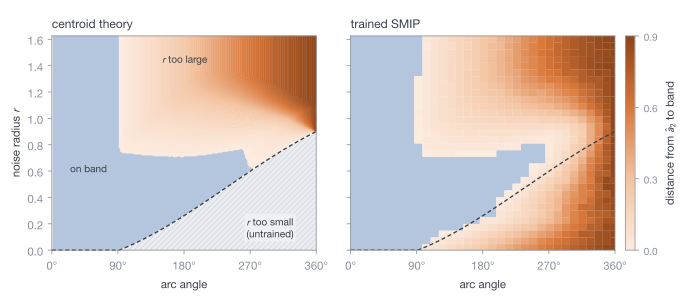
To see how well the theory predicts practice, we sweep both the arc angle and . The interesting region is where the theory is silent: when is too small, the ball around never reaches the band, so head 2 sees an input it never trained on, and nothing says what it outputs.
The trained SMIP matches the theory wherever the theory has an answer. Below about 90°, nearly every works; beyond that, the window narrows and closes around 270°. The dashed line marks where the ball around first reaches the band. Below it, head 2 extrapolates beyond its training inputs: almost nothing lands, and the miss grows as shrinks.
Conclusion
Neither ingredient works alone. Without iteration, head 1 outputs the centroid, as regression does. Without noise, head 2 only ever sees inputs on , so , off it, is an input it never trained on.
A single radius has two jobs: reach from , and stay small enough that looks flat within it. On wide arcs these conflict, and no does both. Diffusion and flow matching split the jobs across steps: early steps use large noise to reach the band, late steps use small noise to stay local. So they handle curves where SMIP fails.
References
Pan, C., Anantharaman, G., Huang, N.-C., Jin, C., Pfrommer, D., Yuan, C., Permenter, F., Qu, G., Boffi, N., Shi, G., & Simchowitz, M. (2026). “Much Ado About Noising: Dispelling the Myths of Generative Robotic Control.” International Conference on Learning Representations (ICLR). arXiv:2512.01809